Someone once said something very releavnt to this scenario -
it’s really about managing emotions.
If one needs to tap the value in the near future,
then holding it in the form of a volatile asset is a sub-optimal decision.
Best to move to stabler/liquid assets or even cash.
The perceived loss over time to inflation is not a concern here as one intends to spend this in the near future anyway.
On the other hand,
if one has no immediate need to tap the value / spend it,
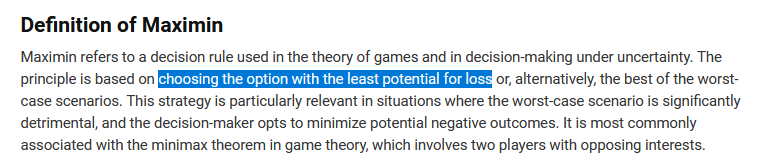
then adopting a maximin strategy right now is sub-optimal.
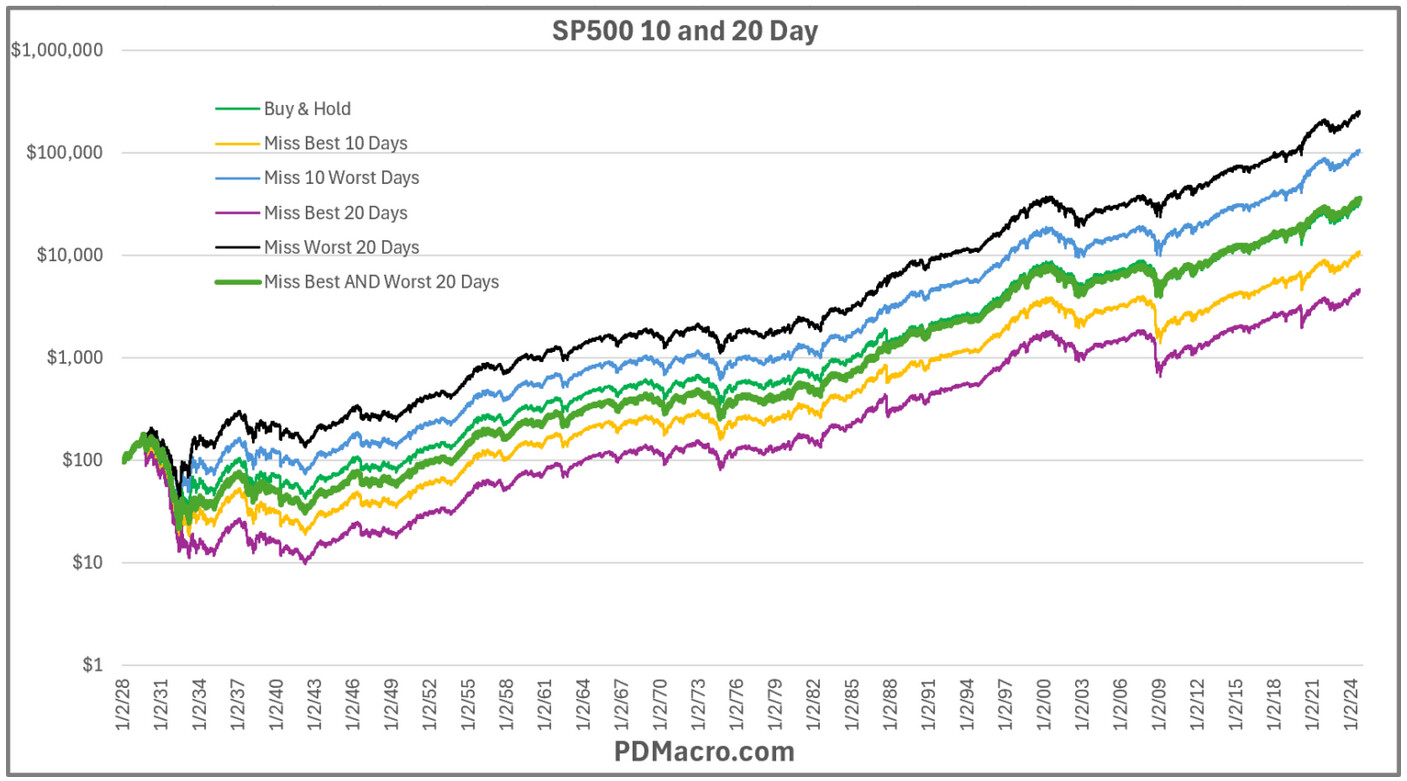
One reason is that the best days and worst days in the market occur close to each other.
While one may try to avoid exposure to the volatile assets in the markets during the worst days, by doing so, one almost definitely ends-up also unable to be exposed to the volatile assets on the best days (closely clustered to worst days), which effectively provide returns close to a buy and hold approach.
Note1: The Y-axis is non-linear, logarithmic scale.
Note2: Based on historical behaviour of close clustering of best and worst days.
[ Source ]
If one has already been exposed to
a volatile asset in the market during a “worst day”,
then by liquidating the volatile asset,
- subsequently potential best-case outcome
- manage to invest back in time to get exposure to the subsequent “best day”.
- achieve returns similar to a buy-and-hold approach.
- subsequently potential worst-case outcome
- miss to invest back in time to get exposure to the the subsequent “best day”.
- achieve returns worse than a buy-and-hold approach.
Basically, significant potential-downside and no/limited potential up-side.
So, not a good choice to liquidate unless one has reasons to believe that
one can accurately time one’s re-entry into the volatile asset in future.
(In general, unlikely).
The following bit from an earlier post in this topic-thread,
attempts to state the above in a very brief/concise manner.
Not sure whether the concise bit gets the point across.
If it didn’t, hopefully this longer post helps. 