If the government is so concerned why aren’t they reducing the STT, or giving employment . The govt is least bothered who is losing, why dosen’t govt bann tobacco and pan masala , because the govt revenue form there is big , really big , now whatever is going on is not because they care for us , they want to increase their revenue and don’t want the retail to lose much . So the Govt and Sebi , Smac members everyone is confused .
I just hope they take a final step , and stop behaving like my GF.
2 Likes
Lot of job loss in capita market industry - in future
more small broker will be bankruptcy because of baby like decision from SEBI
Not everyone can be deciplined trader most traders in our country will always been on the side of gamblers rather than sensible opportunity risk takers which is why govt is concerned because side-effects of alcohol and every other addiction is long term but problems from losing money in option and fantasy can be seen almost immediately not in years,if we compare to u.s they have far more gambling addicts but their per capita helps them escape this financial strain but in poor country like ours it is creating a far more serious concern
1 Like
I know nothing of this, so basically in the same shoes as you are.
Honestly if they allow inverse etfs (even if only with max 1:3 leverage) and also do away with STT - while banning FnO, il b fine with that.
Coming from an FnO trader who earns major part of earnings via trading…
Trading only Illiquid monthly contracts without an economical way to short in the cash mkt will be tough…
4 Likes
A recent SEBI study revealed that retail investors lost ₹52,400 crore in the year ending March 31, 2024, while proprietary traders booked ₹33,000 crore in profits and foreign investors made ₹28,000 crore.
Source: Economic Times
After the ban on online gaming and weekly expiries, one thing is certain: illegal betting will flourish. People will not stop speculating — the only result is that the government will lose revenue.
If the government and SEBI are genuinely concerned about investor welfare, the focus should be on strict regulation of proprietary firms and foreign players like Jane Street. The old Participatory Notes (P-Notes) issue remains a reminder of unchecked foreign speculation. Why should foreign investors be allowed to speculate rather than simply hedge?
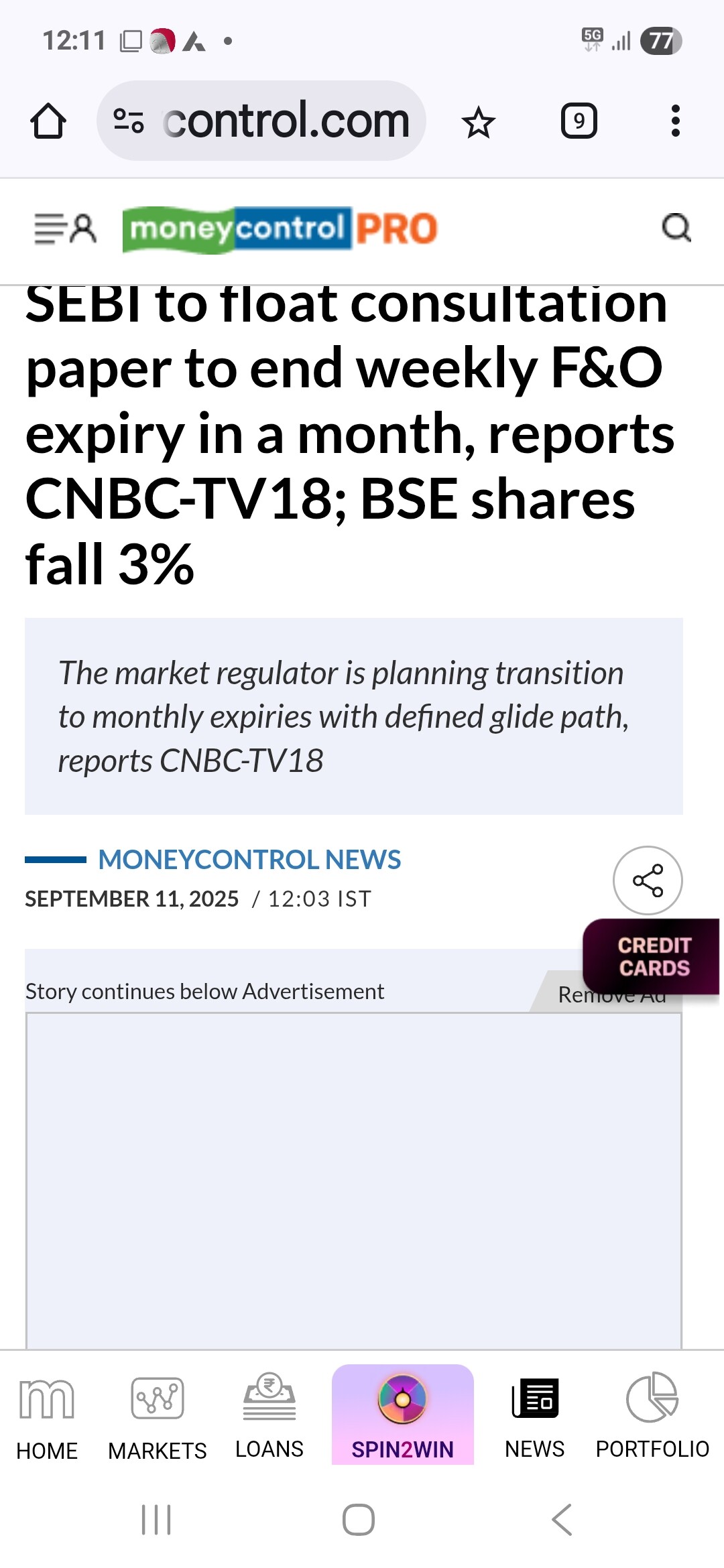
If speculation is the problem, then be decisive: ban F&O trading outright instead of adopting this confusing back-and-forth approach.
Moreover, if “public welfare” is truly the concern, then why are there potholes on every road, no safe footpaths, and rampant corruption among politicians, bureaucrats, police, and even the judiciary? Where is the corrective action there?
This feels like a facade.
Meanwhile, skilled and wealthy traders will simply move overseas. It’s no surprise that Dubai is booming — a tax-free hub with no such restrictions, offering paradise for traders in US options, forex, and crypto.
6 Likes
True because of several reasons . Trump’s highhandness, Gaza war etc etc,. It all started with the lot size increasing to 75 from 25 . Protests were few and far between. Now the Rightists are on top with centrists and leftists at a low ebb. The reason that retail traders are losing 90% bla bla bla are not meant for small retail traders who were making money. It is for the greedy who have lost so much , if the data is reliable. We do not know yet. They want only wealthy traders in the market.
Poor retailers dont dream of becoming jim simons , keep ur savings ( if u have ) in banks and mind your business.
We will facilitate jane street like people to trade and earn more, while u retailers be happy with 2.5 to 5% from bank, it is enough for beg… like you.
2 Likes
@drsennath since you believe that 2.5 to 5% returns from a bank are not worth it. Might be more productive to explore the wide spectrum of investments (with their varying risk-profiles, liquidity, returns, …) between index-options and bank-deposits.
Just because the the conditions surrounding the former i.e. index options are changing (as they have been for more than a year now?), looking at the other extreme i.e. bank deposits and complaining about lower returns doesn’t sound like the next logical step, nor makes for a meaningful discussion. 
Hi with due respect to your views, not only me most of the retailers like me with a moderate portfolio , would have invested in bonds, equity, mutualfunds, index funds etc, which they would have pledged to trade.
The question is how to get the extra 10% yearly returns we used to get from trading, crypto is not a option for me, you can call me as cribbing its ok, But i pay all taxes ,these people have no right to dictate how i use my money unless it is illegal. I know my writings wont change sebi or their bosses, but atleast i am venting out my frustration. If they are really concerned about retailers, as they project themselves to be, they should return all the taxes and stt they got from the losing trades. Isnt this a fair question? About the authenticity of their intention.
4 Likes
The link you posted seems to be targetted at very large positions, 50k lots or so.
So probably this news is perhaps not something to worry about ?
Until next one …
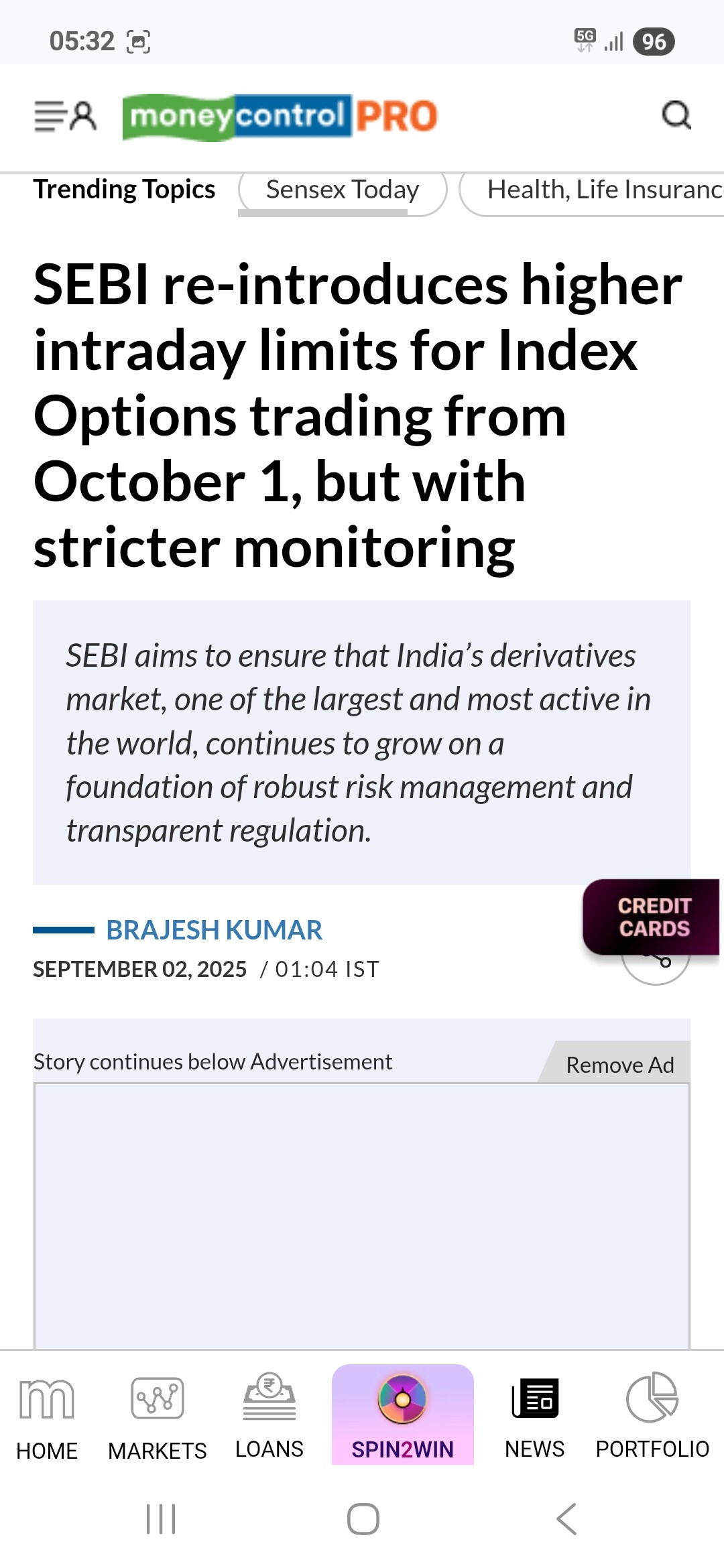
The net intraday position, calculated on a futures-equivalent basis, will be capped at Rs 5,000 crore per entity. The gross intraday position, again on a futures-equivalent basis, will be capped at Rs 10,000 crore, a level that mirrors the existing end-of-day gross limit.
…and having done so, are enjoying he benefits of diversifying into a variety of asset classes. 
Do you have a source for this assertion? or is this based on the narrative popular within the mainstream media, and viewpoints being shared by vocal folks on social-media like this forum.
IMHO, knowing how little to trust them (and/or their expertise), definitely not something to base an opinion on what’s best for oneself (or for that matter even for the majority).
Why does this still need to be earned from trading options?
Also, where is this sense of entitlement coming from? 
- Any thoughts on exactly what value were you providing by trading (and to whom) for which you were being paid 10% annual returns?
- Is it (whatever you were providing by trading options) still of value anymore?
- if yes, is it still the same value or less?
Unlike a govt. pension, earning 10% by trading options wasn’t a guaranteed proposition to generate returns till one gets bored of it, or dies. I think you know that too.
WuT?? “These people” assuming you are referring to the regulator absolutely have the right to do so. We all (yourself included) agreed to that in exchange for access to the regulated markets we participate in. And we continue to do so by voting (both literally, and with our wallets).
Yes, that’s apparent, (from multiple folks) on most of the recent threads on this forum.
I hope all these threads have helped get the frustration out of one’s system,
and now can focus on something actionable to adapt to the latest change in this constantly evolving market.
If this is coming from a tired/panicked/frustrated mind, that is understandable.
But, IMHO, if one genuinely believes this even after calm careful consideration, then it sounds like someone who did not grasp (still doesn’t grasp?) all the risks involved in the market they were/are participating in.
PS: Thank you for continuing to not resort to sarcasm, name-calling, and making arguments in bad-faith (like i have seen several others on this forum resort to, in these frustrating times.) That was precisely why i have ignored other similar recent topic-threads, and i felt that sharing in this topic-thread the contrary opinion that i hold might help steer us towards a productive direction - away from purely venting frustration, and towards identifying something actionable.
Right, no crypto for you.
So what else is (or can be) ? 
FYI, here’s one recent thread that began along similar lines, briefly focused on discussing alternate strategies, and again devolved into venting frustration. Will be continuing the discussion on that topic-thread to understand/explore alternative approaches with the OP on that topic-thread - options trading to hedge one’s portfolio.
When Sebi is so concerned about volatility and market risk due to small positions by retail traders on weekly expiry, why increase position limits for jane street and HFT , wont it create market risk on expiry day?
1 Like
I understand u support the govt. well pl do so. But calling my expectation to earn 10% from trading per year as entitlement! God only should educate u.
Every trader pledges their holdings to trade for extra returns, even questioning this? means your intention is not a fair discussion but parroting the govt view.
What value are u providing by trading? U should ask this to sebi and their bosses ( who brought daily expiry, weekly expiry)whose coffers are filled by tax and stt provided by traders? Brokerage and the entire ecosystem including job opportunities, and the tax they pay arent they value?Trading is not india specific , so all the countries in the world allow something which does not provide any value?
I am not a tired , frustrated mind or who doesnt grasp the situation.It is you who is rigid & petty .
Our views are different no use arguing let us end it here.
But using words like entitled, tired and frustrated mind , to a person who does not agree to your views is petty and mean.
3 Likes
I apologise if it came across as mean.
My intention is to be blunt, yes. But, mean, no.
Please try and ignore any “mean” ness that you might have felt.
No. that’s not what i said.
What i said (and still say) is that
trading using options being viable (10% returns even)
in all potential market conditions
was never a given.
Sure.
In the context of the above described value-additions as the justification,
the regulator has deemed that these value-additions are not worth the costs
(economically, socially, atleast in the short-term/medium-term… ) for now,
and they are attempting to tweak the markets.
(using the knobs available to them.)
IMHO, thinking along these lines, is more productive as it enables us to better predict the general direction the markets are moving in (also isn’t this a significant part of successful trading?) and think about it, and take any action to benefit from it.
Here’s a train of thought, that i sincerely hope helps anyone stuck
venting their frustrations and unable to escape from doing so, to focus/adapt…
...and to hopefully escape this vicious cycle!
i. Does this change in the market negatively affect me in the short-term?
Yes.
ii Does that affect others positively in the short-term?
Yes, the regulator thinks so.
iii. Is this scenario starting to look like the classic trolley-problem?
Yes.
iv. Do i deserve to be discriminated against,
just like the lone individual in the trolley problem who dies if the level is pulled?
No.
However, i also understand that i am not being specifically targeted here.
v. Is there anything forcing me to be the “victim” here?
No.
Unlike the lone person in the trolley problem,
i am not tied to the losing options-trading strategy.
Why trade options if returns are not worth the risk anymore!
Note: This is perhaps the weakest “chain in the link”. There maybe folks whose livelihood depends on their existing options trading strategy continuing to be viable. However, as painful as it maybe, they only have themselves to blame for not reacting to the changing markets until now (how many months has this options market uncertainty drama going on for now?
That said, the age-old adage comes to mind -
“The Best Time to Invest Was Yesterday. The Next Best Time is Today.”
vi. Does this affect me positively in the medium-term/long-term?
-
Yes. The regulator thinks so.
Presumably, just cause i was part of the select few that were net-positive in options-trading so far, it was increasingly unlikely that it would continue to be the case. The odds were increasingly stacked against me, in ways i wasn’t even aware of, but the regulator apparently is aware of. Presumably. -
Yes, if i can adapt to the changing markets and
find the next “10% returns with similar/limited risk” approach.- NOTE: This aspect is in my control. The regulator has very little say in it.
This matches the assertions @TIMEFRAME made a few months ago, that the intraday limits proposed are insufficient to prevent index-options market manipulation by a single entity, especially on the expiry day. I wonder what are these limits based on?
[Source]
Also, the Daily Brief post - Inside SEBI’s crackdown on Jane Street contains a few more numbers specific to Jane Street activities in the Index options markets, when SEBI determined that they were manipulating the market.
Finally, here are
- the consultation paper date 24 Feb 2025 with few proposed limits.
- the previous circular dated 29 May 2025 with few interim limits.
- the latest SEBI circular dated 01 Sep 2025 that talks about the latest proposed limits (end-of-day limits, intraday limits, per-entity limits, steps to acquire additional exposure beyond stipulated limits, …) and the time-frame of gradual implementation and subsequent enforcement.
The circular mentions that the limits were arrived at after consulting with the SMAC / market-makers. So presumably they are some valid reasons why the major players involved (including brokers and major funds houses) need such slightly expanded limits to operate in the markets. Why exactly though?
Hopefully, someone with more practical knowledge of the markets can shed some light on the non-obvious nuances involved on how the updated framework of regulations can improve the market stability as the circulars claim to.
1 Like
My newest unverified conspiracy theory is that STT % and collections will increase now that GST collections will decrease.
Govt has to make up the GST shortfall somehow and traders are a captive audience - taxation without proportional representation.
People who are expecting companies to pass on the GST savings to consumers and that will in turn drive consumption (and thus GDP) higher are way too optimistic and naive IMO. Some companies will have to reduce prices due to competition, but most will simply pad their margins and report higher earnings next quarter onwards. At least higher earnings will support the stock market to some extent.
In addition to GST collection shortfall, they also banned Dream11 etc. which will drive compulsive gamblers to the equity/F&O markets and increase STT collection.
Silver lining is if this conspiracy theory is true then probability of curbs on weekly expiries is lowered.
2 Likes
Yes hiding behind the facade of saving retail traders, sebi and its bosses may do this , as they have done before.
1 Like
This is a pattern now, almost every news like this ends up being a tax hike