101 Beginner Questions — Lessons I Learned from TradingQnA

Indian Hospital sector articles

Three of India’s major hospital chains — Max Healthcare, Narayana Health, and Rainbow Children’s Medicare — and how they performed last quarter. All of them go by different playbooks, making them a good sample set to understand the broader hospital sector.

refer India's hospitals are avoiding the expansion trap

InvITs falling below PB value

Here are the key points and takeaways from the discussion on “InvITs falling below PB value” from TradingQ&A (may include reference from other sources too)

Discussion : InvITs falling below PB Value

:pushpin: Key Insights

  1. INVITs trade below book value (P/B < 1)
    INVITs often trade below 1× book value due to the depreciating nature of their underlying assets—like transmission lines or roads—whose value gradually erodes and often approaches zero at the end of their tenure ([tradingqna.com][1]).

  2. High yield is cash flow, not pure profit
    Yields of ~10–15% in INVITs largely consist of both cash flow and return of capital. Because asset value declines over time, much of the yield is effectively drawing down on the initial capital ([forum.valuepickr.com][2]).

  3. INVITs ≠ REITs

    • REIT assets (land and buildings) often appreciate, partly due to rental escalations and development potential.
    • INVIT contracts (e.g., transmission PPAs) tend to have diminishing cash flows, and the assets themselves depreciate ([tradingqna.com][1]).
  4. End-of-life asset value issue
    At expiry—typically 25–30 years—the value of assets may drop to nearly zero, with little residual salvage. Hence, returns are front-loaded via distributions, rather than via capital appreciation ([tradingqna.com][1]).

  5. Growth requires either debt or equity issuance
    To sustain dividends or grow, INVITs must either:

    • Take on new debt, or
    • Issue fresh equity, which can dilute existing investors ([tradingqna.com][1]).
  6. Structural differences among INVITs matter

    • Some INVITs have BOOM (Build-Own-Operate-Maintain) structures with perpetual ownership potential.
    • Others follow BOOT (Build-Own-Operate-Transfer), where assets are handed over at the end of the contract ([forum.valuepickr.com][3], [tradingqna.com][1]).
    • Asset lifespan can vary—e.g., transmission towers may last 50–150 years—so real-world depreciation might be slower .
  7. Dividend sustainability hinges on new asset additions
    Without fresh acquisition, INVITs are essentially streaming out principal. Therefore, consistent income and yield depend on either acquiring new revenue-generating assets or prudently managing debt ([tradingqna.com][1]).

:brain: Takeaways

  • INVITs are primarily cash-flow instruments, not capital-appreciation plays. You receive your money back over time via distributions, not necessarily at maturity.

  • A P/B ratio below 1 is normative, given asset depreciation—don’t assume undervaluation or “bargains” purely based on PB.

  • High dividend yield = capital return. Effective yield drops over time if you don’t reinvest or add assets, since part of the payment is drawing down your own investment.

  • Comparisons to REITs can be misleading: REITs often ride on appreciating land values and escalating cash flows, unlike INVITs managing depreciating infrastructure assets.

  • Check the INVIT’s strategy:

    • Are they acquiring new assets?
    • Using debt responsibly?
    • Aiming for BOOM vs. BOOT assets?
    • What’s their asset life profile?

:white_check_mark: Investment Checklist for INVITs

Factor Why It Matters
P/B Ratio A low P/B is expected—focus on yield source
Contract type BOOM (perpetual?) vs BOOT (expiry risk)
Asset lifespan Longer lives = slower depreciation
Growth strategy Debt or equity? Acquisition pipeline?
Yield composition Principal vs interest = sustainability

Bottom line:
INVITs are structured to provide consistent cash flows over the asset’s useful life, not to deliver capital gains. A P/B under 1 reflects this design, not mispricing. To evaluate them, dig into their contract structure, asset longevity, and growth strategy. With the right expectations and due diligence, they can be a stable, income-generating asset—but they behave very differently from REITs or equity investments.

References
[1]: InvITs falling below PB Value “InvITs falling below PB Value - Fundamental Analysis - Trading Q&A”
[2]: PGINVIT impairment of investments in subsidiaries and book value - Q&A: Questions & Answers - ValuePickr Forum “PGINVIT impairment of investments in subsidiaries and book value”
[3]: Investing Basics - Feel free to ask the most basic questions - Page 44 - Stock Analysis & Valuation - ValuePickr Forum “Investing Basics - Feel free to ask the most basic questions”

1 Like

Gold Hedge or investment

Gold is often considered a safe haven when equities fall. Here’s why gold tends to perform well during stock market downturns:

:yellow_circle: 1. Gold is a “store of value”

  • Gold has intrinsic value and has been used as money or wealth for thousands of years.
  • Unlike stocks, gold doesn’t represent a business that can lose revenue, fail, or go bankrupt.

:chart_with_downwards_trend: 2. Equity falls = fear rises = gold demand rises

  • When stock markets fall, it’s often due to economic uncertainty (recession, war, inflation, etc.).
  • In such times, investors flee to safety, and gold is one of the first assets they turn to.

:currency_exchange: 3. Gold has low correlation with equities

  • Gold and stocks often move in opposite directions.
  • This diversification makes gold a hedge in a balanced portfolio.

:chart: 4. Gold benefits when central banks cut rates or do QE

  • In bear markets, central banks often:

    • Cut interest rates (bad for banks and bonds)
    • Inject liquidity via money printing (quantitative easing)
  • These actions can lead to currency devaluation and inflation → boosting gold prices.

:dollar: 5. Gold is seen as a hedge against currency devaluation

  • If equities fall due to poor economic policy or high inflation, fiat currencies (like INR, USD) may weaken.
  • Gold is priced in those currencies, so when they fall, gold prices rise.

:moneybag: 6. Flight to physical/tangible assets

  • During financial crises, paper assets (stocks, bonds) may seem risky or uncertain.
  • Gold is a real, tangible asset you can hold—this appeals to investors in times of distress.

:bar_chart: Example: COVID-19 Crash (March 2020)

  • Equity markets crashed → Gold initially dipped (liquidity panic) but then surged.
  • In 2020, gold crossed ₹55,000 per 10g in India as investors ran to safety.

:white_check_mark: Summary Table

Reason Impact on Gold
Stock market panic ↑ Gold demand
Inflation ↑ Gold as hedge
Currency weakening ↑ Gold price in INR/USD
Low interest rates ↑ Appeal of gold (no yield needed)
Uncertainty (war, recession) ↑ Safe-haven buying

Discussions

  1. China Gold Fraud - How safe are the Gold ETFs?
  2. India’s Gold Reserves Just Hit a Record High
  3. Gold ETF as non-cash component
  4. New RBI rules around Gold Pledging
  5. Why are SGBs trading below their intrinsic value?
  6. What is gold price Prediction for 2025?
  7. Is gold really the “safe haven” everyone thinks it is?
1 Like

Shares due for transfer to the Investor Education and Protection Fund (IEPF)

Based on the information received from the concerned companies, the following shares held by you in demat account 1XXXXXXXXXXXXXXXXXX with ZERODHA BROKING LIMITED are due for transfer to the IEPF Authority :

Screenshot 2025-06-29 at 12.34.39 PM
2070×196 52.1 KB
In light of the above, you are requested to kindly update your bank details on an urgent basis with your Depository Participant (DP) to enable the remittance of any unclaimed dividends held by the company. This may also help prevent the transfer of your shares to the IEPF Authority.

We also request you to update your bank details in any other active demat accounts held by you. The details of the same may be obtained from the Consolidated Account Statement (CAS) which contains details of securities held by the investor across all demat accounts and Mutual Funds held in physical form.

Discussion happening in this thread : I got this email can anyone explain this

Mind over markets
A curated collection of 600+ short essays on trading psychology, originally published (2002–2007) by Marketwise, now republished by Zerodha with permission.
It emphasizes that successful trading depends not just on strategy, but hugely on mental fitness—how you prepare, react in the moment, and process outcomes .
read from this link Innerworth - Mind over markets – Varsity by Zerodha
Discussion : Innerworth - a must study for everyone

1 Like

Important Daily Reports and announcements links from Zerodha team
I hope I haven’t missed any important details. If I have, please feel free to ping me so I can add them.

1.After market report - Aftermarket report - Trading Q&A by Zerodha - All your queries on trading and markets answered
2. Daily brief - The Daily Brief - Trading Q&A by Zerodha - All your queries on trading and markets answered
3. Industry Insights - Industry Insights - Trading Q&A by Zerodha - All your queries on trading and markets answered
4. Announcements - Announcements - Trading Q&A by Zerodha - All your queries on trading and markets answered
5. Feature announcements - Zerodha Feature Announcements - Trading Q&A by Zerodha - All your queries on trading and markets answered

List of all Indian Exchange Traded Funds (ETFs)
All ETFs can be bought and sold on Kite (Article Zerodha team). To buy an ETF, just search for the symbol>add to your marketwatch and place an order.

Refer : List of all Indian Exchange Traded Funds (ETFs)
Discussion : List of all Indian Exchange Traded Funds (ETFs)

How to use Browser search option not the tradingqna search
When we use command + f button usually tradingqna search option will popup , so we have to open links . If use browser search option , we can use next or prev buttons to find the match . One way we can overcome this by click on the address bar and use command + f (or control + f) then it show the browser search bar . It Help me lot on finding the details fast .

1 Like

Extended market Hours

Is it time for India to rethink its stock market hours? While global markets run well into the evening, we’re still closing shop at 3:30 PM. Are we limiting investor participation—or just avoiding the extra volatility?" For active traders, extended hours could mean more flexibility, better alignment with global news flow, and improved hedging opportunities. For retail investors juggling day jobs, evening sessions might finally level the playing field. And for regulators, this raises a key question: Can India modernize its market infrastructure while balancing liquidity, risk, and investor protection?

Discussion : Nithin Kamath’s vision of achieving 10 crore+ active traders in India

I believe it’s time India considers extending stock market hours—perhaps from 9 AM to 9 PM—similar to global markets. Longer hours could offer retail traders more flexibility, better alignment with international markets, and increased participation. Of course, I understand there are concerns around operational load and trader burnout, but with proper structure, it might be beneficial for all. What do fellow traders think—would extended hours help or hurt our trading performance and mindset? Let’s discuss.

Convert FNO profits to STCG
Strategy by @Jason_Castelino
Idea: Convert high-tax F&O income (taxed at slab/business rates ~30–31.2%) into lower-tax STCG (15%) using deep ITM options and physical delivery:
Here Is the steps what I understand from the discussion , If wrong please send me message , I will update this post . For discussion please check out the discussion link given in the bottom of this post .

Step-by-step Flow:

  1. Buy deep ITM call (current month):
    You pay a large premium, deep in-the-money, close to expiry.
  2. Sell futures (next-month):
    You simultaneously short the futures contract of the same stock for the next month.
  3. Option expires in-the-money:
    You accept delivery of the shares via the ITM call.
    These shares are credited to your demat account — and this delivery-based acquisition becomes a capital asset.
  4. Sell shares (spot) next day or soon:
    You book short-term capital gains (STCG @ 15%) if sold within 1 year.
  5. Futures position now becomes your hedge:
    You are short in futures and long in shares.

Discussion : Tax Planning: Convert FNO profits to STCG

1 Like

Why SWP Is Better Than the ‘Dividend Option’
There is a live discussion in the tradingqna forum started by @Quantum_AMC , these are the things I learned from this discussion . If any thing I miss or mis understand plz do send via message . I will update here .

  • Systematic Withdrawal Plan (SWP) offers more tax efficiency and control than the Dividend Option, especially after Budget 2020. Earlier, mutual fund dividends were tax-free in the hands of investors, but the 2020 budget shifted the tax liability to investors according to their income slab. This change made the Dividend Option inefficient for those in higher tax brackets. In contrast, SWP allows investors to redeem a fixed amount periodically from their mutual fund investments, where only the capital gains portion is taxed—and if held over one year (for equity funds), only at 10% for gains above ₹1 lakh, making it more tax-friendly. Furthermore, SWPs provide predictable cash flow, and investors retain control over the withdrawal frequency and amount.

  • On the other hand, dividends are not guaranteed, as mutual fund houses declare them based on distributable surplus and market conditions. This unpredictability can disrupt cash flow planning, especially for retirees or those relying on periodic income. In comparison, SWP allows investors to customize withdrawals irrespective of whether the fund declares any dividend or not. Moreover, with SWP, the remaining corpus continues to stay invested and can grow, offering potential for compounding over time. This flexibility and control—combined with post-tax advantages—make SWP a superior choice for long-term income-seeking investors.

Refer discussion : Why SWP Is Better Than the ‘Dividend Option’ Post-Budget 2020

Enhancing Our trading experience with AI
Kite MCP allows you to connect Zerodha Kite trading platform to AI assistants, enabling us to:

  • Query Our holdings, positions, and order history using natural language
  • View and create GTT (Good Till Triggered) orders
  • Get live quotes for instruments

Please note that the order placement facility is currently not available as this tool is in its beta stages

Refer Discussions for more details :

  1. Introducing Kite MCP: Connect your Kite account to AI assistants
  2. Zerodha’s Claude AI portfolio advisor!

Interesting retirement corpus discussion
The context of the TradingQnA post revolves around a user asking for guidance on how to invest ₹40 lakhs with the goal of building a ₹6 crore retirement corpus over 20 years. Contributors provided various strategies, emphasizing the importance of a sound financial plan. Notably, users stressed avoiding commission-based advice and focusing on behavioral aspects like curbing lifestyle inflation—highlighting that financial discipline can matter as much as investment returns.
An active forum contributor, @cvs , highlights that simply choosing between “safer” predictable investments or “riskier” high-return ones misses the bigger picture. A powerful third tactic: limit or avoid lifestyle inflation now (e.g., reduce discretionary spending) so you can either:

  • Allocate more toward long-term investments, or
  • Achieve your retirement goals with lower-risk products
    This boosts compounding benefits and reduces the need for excessive risk-taking .
    You can view the full discussion here: TradingQnA Thread

low-cost NAV ETFs
Are you a fan of low-cost NAV ETFs, or still exploring your options? We’re having an interesting discussion on low cost ETF offering — would love to hear your thoughts!
Discussion page : Why hasn't Zerodha launched a ₹10 NAV Nifty 50 ETF yet

I am getting issue to get the login link for kite and after click in link putting on credentials for authentication i am getting error missing token

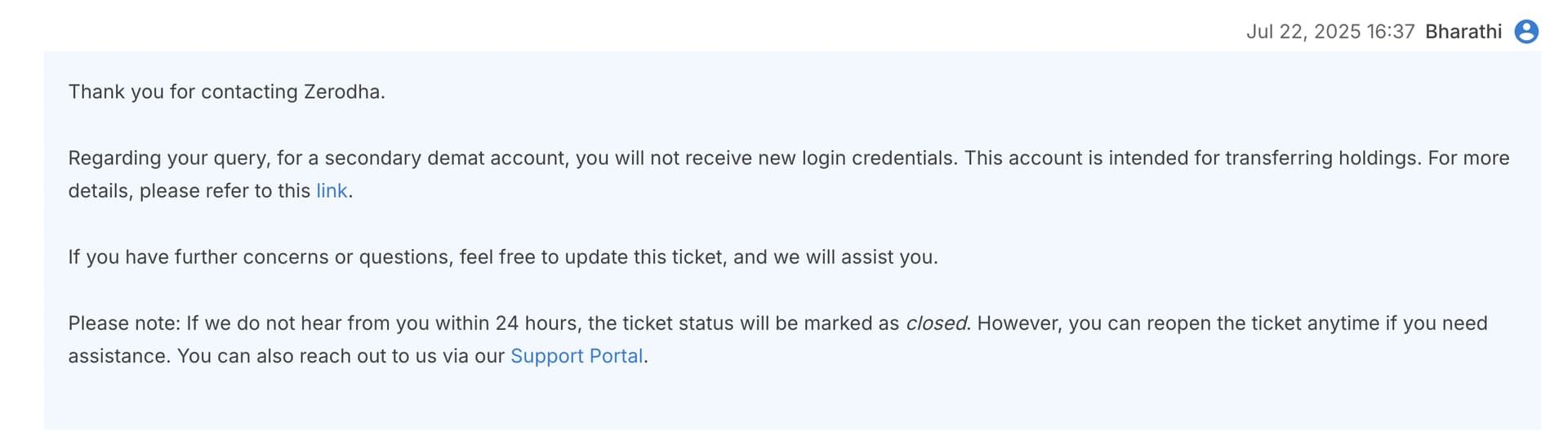
Zerodha Secondry Demat Opening

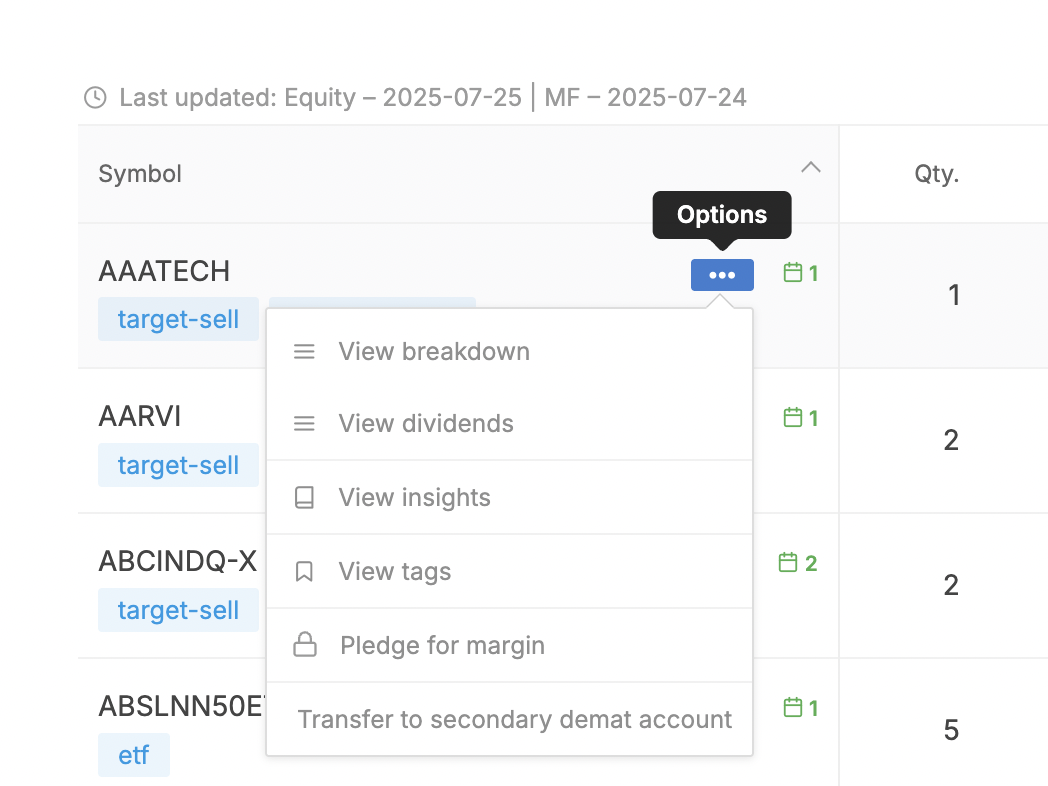
  1. A secondary demat account for long-term portfolio.A secondary demat account with Zerodha to separate our long-term investments from short-term trades.
  2. Tax optimisation through FIFO management
  3. transfer options
    We can transfer Our long-term holdings to a secondary demat account to ensure Our short-term trades aren’t affected by FIFO
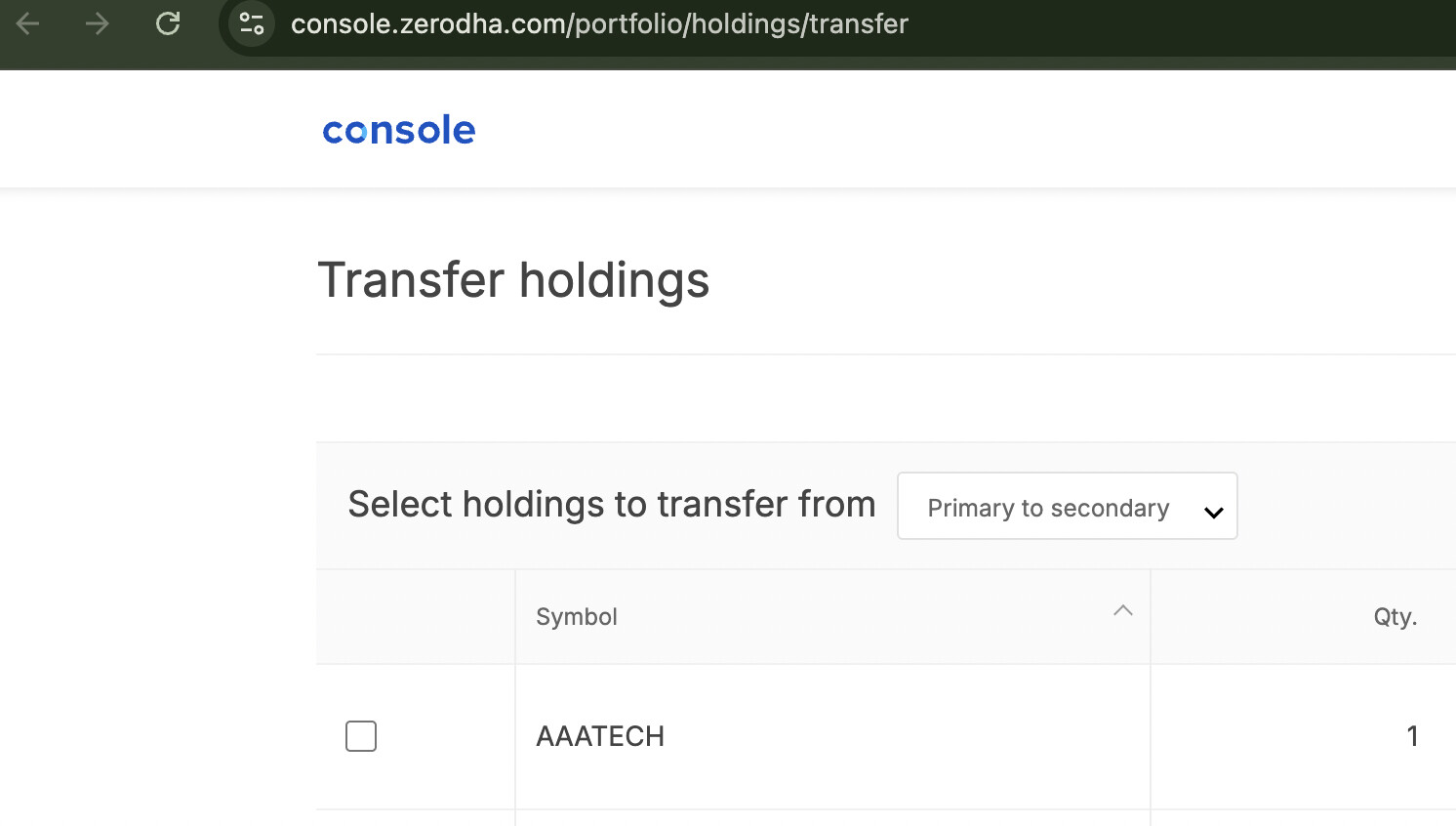
    Single stock - Transfer via console


Multiple stocks
To Initiate the transfer , Visit console.zerodha.com/portfolio/holdings/transfer.

  1. Discussion : https://tradingqna.com/t/instead-of-just-one-holding-portfolio-can-we-have-multiple/

Few more details

When you move your long-term holdings to a secondary demat account, they won’t appear on your Kite platform, though you can still view them on Console. This separation helps you maintain discipline by reducing the temptation to trade your long-term investments impulsively. refer this link for more details What are the benefits of opening a secondary demat account with Zerodha?

1 Like

Zerodha demat share is shrinking - how we can help
Nithin Kamath had acknowledged the shift himself, stating, “Our AUM share is growing… but our demat share is shrinking.” He added that younger users—especially from tier 2 and 3 cities—are increasingly choosing other platforms. Kamath’s core question: Can legacy strategies still drive growth?
Entrepreneur Ankur Warikoo responded

He also called out Zerodha’s brand language and product names—Kite, Coin, Varsity—as sounding technical and uninspiring to Gen Z. “To most people, it sounds like ‘zero-something.’ It doesn’t feel aspirational,” he noted, contrasting it with brands like Groww and Upstox.

Among his suggestions: unify Zerodha’s apps, introduce social investing tools, create relatable content in Hinglish, and show up where young investors actually are—gaming streams, college fests, meme pages. “You don’t have to run ads. But you have to show up in their world,” he wrote.

Zerodha’s problem, Warikoo concluded, isn’t performance—it’s presence. “Zerodha has earned trust. Now it needs to earn attention. Not through noise. But through relevance and culture.”

Refer article : 'Zerodha is accurate but...': Ankur Warikoo tells Nithin Kamath why Gen Z won’t sign up - BusinessToday

My thoughts

Zerodha’s sleek, minimalist apps (Kite and Coin) are great to use.
If you’re a full-time or regular trader/investor (I’m not a regular trader due to Indian market timing restrictions), then Kite feels like a gift.
However, the younger generation may prefer a super app that offers a centralized experience — combining buying, news, events, F&O tools, screeners, algos, automated SIPs, mutual funds, and more. - create a seperate super app , any way Zerodha have many apps combine these in a single app and present to new users . let the active users use the kite for trading (so legacy and fantasy will run together for a larger goal ).

Based on my experience, Zerodha also has some flaws in the onboarding process.
I’ve mentioned this in the discussion here:
:link: Our AUM is growing but new signups are slowing. What would you do? - #12 by sandeep_cs

Zerodha’s vast content library — including Varsity, TradingQnA, webinars, blog posts, and support articles — is a major strategic asset, but whether it’s an opportunity or a missed opportunity depends on how it’s used. There is no need of paid ads but these assets should spread to the required .

  1. Curate Focused Learning Paths . Instead of sharing go to Varsity, share:
  • Top 5 Varsity modules for beginners
  • 3 articles from TradingQnA that explain margin rules
  • Step-by-step options strategy + video + example basket order
  1. Localize and Simplify
  • Create regional explainers in Hindi, Tamil, Malayalam, etc.
  • Build bite-sized 1-minute explainers from long articles.
  • Use WhatsApp/Telegram groups to distribute curated Zerodha content.
  1. Merge Learning With Action
  • Link Varsity lessons with live demo trades on Kite.
  1. Use Content to Onboard New Investors - When someone opens an account, you can:
  • Send a 30-day content journey (email or WhatsApp) using existing Zerodha content.
  • Add tips like How to create a SIP on Coin,with links to their guides.

We can discuss our suggestion in this forum post (Hope every one can add some points to improve new signups)
visit this forum link to share Your thoughts and suggestion : Our AUM is growing but new signups are slowing. What would you do?

Indices that track gold and silver
Curious to know - Are there any Indian stock market or MCX indices that track the performance of gold and silver prices? . @SG_13 pointed about MCXGOLDEX and MCXSILVDEX .
visit this Forum discussion for more details from other users : Do we have any indices that track gold and silver? - #3 by SG_13
Reply from Vishal Jain CEO @ Zerodha Fund House

Gold & Silver are an individual underlying and as far as i know MCX does calculate a landed price of Gold through a polling process and so does IBJA. Its important to note that in the absence of a commodity spot exchange in India, there is no single closing price of Gold or Silver. refer Do we have any indices that track gold and silver? - #6 by VishalJain

Check Today Gold price

https://groww.in/gold-rates

Join the discussion : Do we have any indices that track gold and silver?

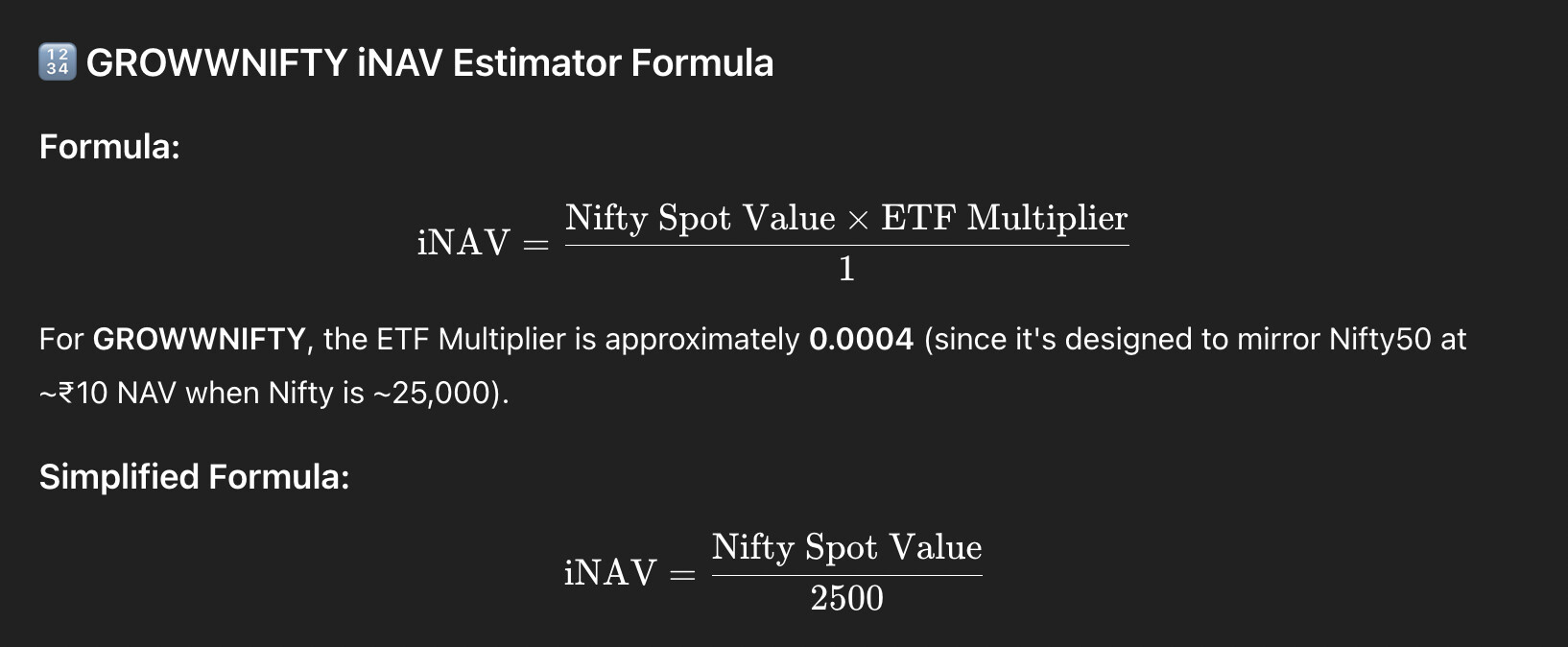
Design a Nifty Spot to iNAV Estimator formula
Lately, I’ve been experimenting with ChatGPT to design a Nifty Spot to iNAV Estimator formula , and it’s been a game-changer for my ETF tracking! Now, I’m working on building a custom spreadsheet for my ETFs (excluding gold and silver) to simplify my buying decisions. One thing I’ve noticed — the iNAV displayed on exchanges often lags or doesn’t update in real-time (anyone else faced this?). So, I’ve started manually calculating an approximate iNAV to get a better entry point, especially for my GROWWNIFTY ETF purchases.
Curious to know—how do you track ETF iNAVs during market hours? Do you rely on exchange feeds, or do you have your own method? Let’s discuss! :point_down:

Checkout the Discussion page for more details : Design a Nifty Spot to iNAV Estimator formula

Research-Enhanced Index Equity (ESG) ETFs - passive and active in a single ETF
Any one heard about Research-Enhanced Index Equity (ESG) ETFs - passive and active in a single ETF ? . Do we have any of this type etf in India ?
Got this info from this source Passive and Active in One Equity ETF Strategy | J.P. Morgan Asset Management

REI blends passive design—such as sector, regional, and style neutrality—with active management rooted in analyst-driven stock research. It aims to mimic the broad market’s risk profile while generating modest but consistent alpha via small stock-level deviations from the index.

For more details visit discussion page : Research-Enhanced Index Equity (ESG) ETFs - passive and active in a single ETF

A simple method to learn Intraday and learn/ improve risk management
Thanks @Rajesh_K1 for the lessons

Select any 1 good stock you like.

  1. the stock you choose should be very liquid and whose movment has less wicks and moves in tendem with Index nifty. ( try to choose any one from nifty 50 bucket)
  2. only trade in this stock with only 1 quantity, this will eliminate you fear for loss and excitement for profit because the amount will be very small and insignificant.
  3. lean the price movment with volume and in different scenarios.
    Example: how stock or price behave after a big move,
    How it move during choppy days
    When in consolidation how it moves etc.
  4. Trade in this stock with 1 quantity till you start turning wining 7 out of 10 trades in a day and say atleast 16 days in profit out of 22 trading days in month.
  5. When you start winning for 16 days in a month, then refine it further where say for every 10 rs your profit is 7 against loss of 3.
  6. When you successfully achieve till point 5 then start doubling your stock quantity every month.
  7. And most important, be honest with your strategy and trading.
    Remember trade will come back again next day, your money will not.
    So don’t lose it.
    refer : Intraday loss- need suggestions - #11 by Rajesh_K1

My Experience

I had been trading intraday earlier. In fact, I was trading Ambuja Cement when the 2023 Hindenburg report news came out and took a sudden loss. I was shocked. That experience made me stop intraday trading. My stop-loss and risk management weren’t right, so I decided to switch to ETFs instead. Now, I only focus on swing, positional, and long-term trades.
I’ll definitely try this method to improve my risk management strategy and continue learning.

2 Likes

Streak platform - Indicators for higher highs and higher lows
Issue:
A trader on TradingQnA asked how to detect higher highs and higher lows using the Streak platform. They had tried using the PREV N function but found it difficult to create consistent, reliable logic for identifying these patterns. The lack of a built-in indicator meant users had to manually configure conditions, which was prone to errors and time-consuming for backtesting or live deployment.
refer : Indicators for higher highs and higher lows
Solution:
In reply, the Streak support team suggested a practical workaround—using Period Max and Period Min indicators to simulate higher-high and higher-low detection. By comparing the most recent high to the Period Max of a set look-back period (and similarly, the recent low to Period Min), traders could approximate the desired pattern recognition until Streak introduced native higher-high/higher-low detection in a future update.
refer : Indicators for higher highs and higher lows - #7 by Krishnendu

SLBM - next passive income stream for small investors?

Renting Our stocks via SLBM (Stock Lending and Borrowing) . Securities Lending and Borrowing (SLB) allows Us to lend or borrow securities at specified prices and timeframes . Waiting for Zerodha’s online option (currently offline )
. Dhan offer amazing SLBM interface for it users.

Discussion : SLBM - next passive income stream for small investors?

References

  1. Current Zerodha offering : What is Securities Lending and Borrowing (SLB) and how to avail it?.
  2. What is Stock Lending & Borrowing? - SBI Securities

Just saw this post, so replying a bit late -
I take few thousands of trades in a year in stocks. Below is just my opinion.

Excel maths dont work in small sample.

  1. You will need hundreds of trades to get some idea of your Expectancy / win rate / win per trade etc. But even that can depend on current environment.

  2. These numbers (7 out of 10 etc) are somewhat meaningless in a vaccum. We need to see what the market gives rather than impose arbitrary conditions. Good Win rate and average win are not set in stone, for some systems a high win rate could be good, another may be dependent more on outliers and a lower win rate could be more optimized. For ex, 2 of my systems have win rate around 50% and 35%. The 35% system, i can run at 60% win rate by reducing holding period but then overall its significantly worse.

  3. Market environments change a lot. Thats why we need a long term backtest ideally 10y or so. And we need to diversify. One of my system had an extremely strong performance last FY. Just too much, my best ever in a single system in a single FY. That one is in DD since mid march. Thats the way it is, i have had tough periods for 7-8 months in a single system multiple times. Markets dont give easy clear path all the time. Things are uncertain and stuff can stop working too and we may need to adapt.

  4. So you can’t just look at a small sample, apply some arbitrary conditions and then when it starts working assume that you have some thing that works.

I do agree to keep size small and keep trying and figuring out what works for you. Just be mindful of above. Good luck.

1 Like

Un-Claimed Dividend
Top RTAs in India

Notes and dislaimer: For Shares (listed companies) - as per my Understanding , before signup or sharing information please do your own research .

Discussion : Intimation regarding Un-Claimed Dividend against Masked PAN